interviews
Relaxation areas or spas?
Wellness in prestigious situations
Interview with Daniele
Cantoni by Nennella Santelli
From Les Nouvelles Esthetique Magazine
Issue N. 03 | 2005
We have asked Daniele Cantoni, expert and indisputable
leader over the past twenty years in the cosmetic, beauty
and wellness sectors, to talk to us about the evolution
of the concept of wellness [which has really boomed]
and about what people expect and want out of a so called
"spa area".
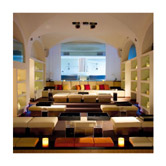 Nennella
Santelli: You design and create relaxation areas, spas
or wellness areas in prestigious places ranging from
hotels in "vacation paradises" to spas in
the city. To date, what has been your contribution to
wellness areas within the world of classical Esthetic
Institutes? Nennella
Santelli: You design and create relaxation areas, spas
or wellness areas in prestigious places ranging from
hotels in "vacation paradises" to spas in
the city. To date, what has been your contribution to
wellness areas within the world of classical Esthetic
Institutes?
Daniele Cantoni: Most of my work takes place through
an inverse process: creating esthetic areas within the
context of large wellness centres. In the few cases
where a esthetician has contacted me, wanting to add
on an area dedicated to wellness, I have always made
it a point to give a thorough consultation, sometimes
even before I began the design and creation phases.
At times, to the client's amazement, I have discouraged
him from creating the area because I didn't feel that
it would have been worth the financial investment. Oftentimes
the esthetician, as most other business people who seek
the help of my company, decides to create a wellness
area more out of impulse than out of a real financial
need for it. On the basis of this assumption, many people
who call themselves professionals, take advantage of
their clients' inexperience, promising unrealistic earnings
that cannot be demonstrated by actual calculations.
N.S.: What do you consider to be the minimum dimensions
necessary to create a wellness area with water equipment
in an average-sized esthetic centre?
D.C.: The size in meters is relative. The important
thing is not to fall into the trap of installing a pre-defined
package, which the esthetician then finds himself "forced"
to adapt to. A careful analysis must be made regarding
the centre itself, the competition and the techniques
and products that it employs, in order to create a wellness
area that will perfectly marry with the existing culture.
This is the only way to create synergy rather than contrast,
which is so often the result. I must stress that the
esthetician should not make the mistake of creating
a wellness area without having first verified the financial
yield it will have through a meticulous business plan.
She must also remember that, beyond the "fulcrum"
of the wellness area itself, a certain amount of space
must also be dedicated to the relaxation area, the technical
area and the dressing rooms. The minimum dimensions
of a wellness area, created in a "suite" style,
would start at 40 square meters.
N.S.: What are the options and materials that you
tend to prefer when designing a wellness area?
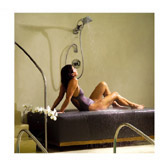 D.C.:
Besides the normal evaluation of materials based of
their durability and ability to "breathe"
which is fundamental in the steam areas, my colleagues
and I do extensive research to discover which shapes
and materials best "facilitate" the cleaning
and hygiene of each of the facilities. For those who
are unable to visit SPA CONCEPT's website to see for
yourselves, our style is pure and essential, thus allowing
us to avoid the use of unnecessary borders and recesses
where dust and dirt accumulate. Because we are constantly
researching new options, we use all kinds of materials,
without getting stuck in a rut of using the same formats
over and over again. Lately, for example, we have been
making wood floors with bamboo which, besides being
spectacular looking, has the durability necessary for
a wellness area. D.C.:
Besides the normal evaluation of materials based of
their durability and ability to "breathe"
which is fundamental in the steam areas, my colleagues
and I do extensive research to discover which shapes
and materials best "facilitate" the cleaning
and hygiene of each of the facilities. For those who
are unable to visit SPA CONCEPT's website to see for
yourselves, our style is pure and essential, thus allowing
us to avoid the use of unnecessary borders and recesses
where dust and dirt accumulate. Because we are constantly
researching new options, we use all kinds of materials,
without getting stuck in a rut of using the same formats
over and over again. Lately, for example, we have been
making wood floors with bamboo which, besides being
spectacular looking, has the durability necessary for
a wellness area.
N.S.: How do you view the union of the two concepts
of technology and nature in a place where one goes to
get away from all the aberrant situations of everyday
life? Because I think that in a real wellness area one
must avoid, as much as possible, contaminating the environment
with both electromagnetic and noise pollution.
D.C.: I view it well, if it's done professionally, fully
respecting the balance between nature and man. Great
attention must therefore be given to the materials used
and to what I call the "lungs" and "kidneys"
of a wellness centre: the air-conditioning system and
the filters for the pools and hydro-massages. With regards
to electromagnetic pollution, our company makes hammams
and aromariums that are heated by special water circuits,
rather than using the ones heated by electrical resistance
that are so often found on the market.
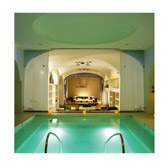 N.S.:
How is it possible to create a concept of "pluri-sensoriality"
in a SPA or esthetic centre? N.S.:
How is it possible to create a concept of "pluri-sensoriality"
in a SPA or esthetic centre?
D.C.: Look at the example of the SPA-CAFE'. I came up
with this concept to add the sense of taste to the four
senses which we already stimulate in a person in normal
wellness centres. Touch is stimulated through the materials
which, many times, are heated [I have often noticed
clients who, during their treatments, unconsciously
caress the surface they are laying on]. Sight is stimulated
through relaxation areas which are no longer relegated
to the basement level. Hearing through perfect sound
insulation, which is a very complicated thing if you
consider that a simple water surface can exponentially
amplify the slightest noise in a given area. Smell...
research has shown us new, completely natural methods.
At the moment, we are perfecting a simple and innovative
idea in an prestigious spa that we're building in the
Tuscan hills. With the SPA-CAFE', my main objective
was to add the "sixth sense" - the pleasure
that comes from an environment where wellness, music,
shows and refreshment create a synergy together that
amplifies sensations and emotions.
N.S.: Can you give us a general idea of the financial
investment necessary to create several different areas
in an esthetic centre?
D.C.: Because of the philosophy I maintain, I tend to
create spas that are different one from another. However,
to give you a basic idea, I would suggest that one should
plan to invest between 700 and 1.000 euro per square
meter of space. Keeping in mind that both a Fiat and
a Mercedes are useful for transporting people, however...
|