interviews
A Custom-made Spa
Interview with Daniele Cantoni by Cristina Sarto
From Area Benessere Magazine
Issue N. 1 | January-March 2004
You can call it a wellness center, a spa or a relaxation
area. And you can keep considering it a perk. But it's
a good idea to remember that a hotel that has installed
a facility like this will be able to increase its rates
by three to twelve percent. And don't be fooled... within
five years, it will become a must in all facilities
that offer accomodations. From the chalet nestled in
the shadow of the Dolomites [where the installation
of wellness areas has already been a fact of life for
several years now] to the vacation resort along the
coast. "It's a sort of natural evolution, a bit
like the private bathroom in the hotel room. In the
70s it was considered a plus in Italian hotels, but
now it's taken for granted. It was the same with the
television, the mini-bar and even the swimming
pool". These are the words of Daniele Cantoni,
who boasts twenty years of experience in the cosmetic,
beauty and wellness fields. This is a sector in which
Italy is slowly developing its own niche and our expert
is undoubtedly one of the leaders.
What is a person who wants "wellness" looking
for today?
They're no longer looking for low calorie diets or exhausting
workouts, but to be pampered. Let's take a "day
spa" for example. The customer doesn't go there
to suffer and get back in shape, but to offer a relaxing
shiatsu massage to one of his business clients or to
choose from a selection of the best chocolates in the
world.
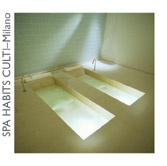 When
a hotel owner asks you to create a wellness area, what's
your first step? When
a hotel owner asks you to create a wellness area, what's
your first step?
I figure out what the client's objective is, which can
differ greatly from one situation to the next. One hotel
might need to increase its business during high season,
another might need to have more business out of season
and yet another might need new clients altogether. This
is the case, for example, with those hotels that lived
principally on American tourism. To make up for the
decrease in American tourists, they have had to appeal
to another type of market. Drawing up a project for
a wellness area is a bit like making a custom-made
dress. The first step is to evaluate what the client
really needs - the mission, yes, but also the the
geographic location, the customer's needs, the competition.
It's not enough to just build. The average construction
company builds about 50 wellness center per year. How
can they also have time to analyze the needs of the
client? How can they estimate how much energy the center
will consume or recommend the best hours for business?
Are there any situations in which a wellness area
cannot possibly be successful?
No, not if certain conditions are respected. The first
is that the project must be studied inside and out,
considering all of the variables. At the moment, I'm
working to create a wellness area in a hotel near an
airport. Starting out with the assumption that 80% of
the clientele will be somehow connected to air travel,
I'm analyzing what is necessary to offer a sense of
wellness to this type of target group. What kinds of
treatments will help them get over jet lag? Which are
useful to reduce swelling in the legs, etc.?
And the second condition?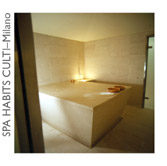
Not making the mistake of building a facility and then
deciding afterwards what your objectives are. For example,
you can't build a standard wellness facility and then
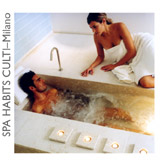
try to target business managers. You have to plan rooms
with two beds for massages or two whirlpools, so that
the businessman can take advantage of that relaxing
time to talk to one of his clients. The distance between
the two whirlpool tubs must be carefully studied. If
they are too far apart, it will be difficult for the
two to talk, but if they are too close together, you
violate the privacy of two people whose relationship
is essentially work-related. It's an enormous mistake
to have a facility built before establishing your objectives,
as it will likely feel sterile and have no character
of its own.
Steam rooms, gyms, swimming pools, beauty areas,
relaxation rooms, children's areas - wellness is
a puzzle made up of many pieces. What should a business
person concentrate on to make his or her center work?
This is also a subjective choice, that varies from situation
to situation, although there are a few elements that
are becoming indispensable. The lounge area, for example,
for socializing while listening to music. Or the relaxation
room, the area where the customer, following his baths
and treatments, realizes how much he has enjoyed himself
and decides that he will come back. But apart from the
different areas, it's important to have a director who
gives personality to the center and is a reference point
for the clientele. For this precise reason, I don't
recommend having wellness centers built and then run
by outside companies. Just as one would never think
of hiring an outside catering company to run his hotel
restaurant's kitchen, a wellness center should be coordinated
by someone who works in the hotel. If a wellness area
is "separate" from the hotel and is not in
synergy with the rest of the environment, the clients
will sense that. There should always be a common thread,
an atmosphere of oneness, as if all the employees smiled
in the same way. Let's not forget that wellness is a
global value. Even minor details that are out of place
have an effect on the client's perception of quality.
 What
will the wellness centers of the future be like? What
will the wellness centers of the future be like?
First of all, they will be more spacious. The use of
space is one of the determining factors in wellness.
We live in a world where even the smallest spaces are
exploited down to the last centimeter and this causes
us to suffer. For this reason, a person must never feel
cramped in a wellness area. He or she must feel free
and able to breathe. In order to respect this principle,
very precise limits should be placed upon the number
of people who can enter each single area at a time.
Of course, you must allow enough people in to at least
reach the break-even point, but you should be careful
not to infringe upon their need to feel that they have
enough space. Secondly, they will be run by fewer employees.
Today there is an average of about 3 technicians per
client in these facilities, but this proportion will
eventually be inverted. This is because the areas will
become more and more functional. The client should feel
that he is being "taken by the hand" without
noticing the presence of too many employees. This will
also be possible thanks to certain equipment that enables
a sense of wellness to be communicated without constant
personnel supervision. From a managerial point of view,
this means higher earnings and fewer expenses.
And then?
Much more attention will be given to selecting natural
solutions and construction materials. An example? The
use of light. In the centers that I create, we study
the lighting situation so as to make the sun's rays
shine by way of refraction into the turkish bath, as
they did in such facilities long ago. Artificial light,
which is reduced to a minimum, is always under water.
As it is, we live in contact with electric contamination
and acoustic and electromagnetic pollution from morning
to night. In order to feel better, our organism needs
natural things. The client immediately senses this line
of thinking. Many people have already begun to distinguish
the difference between a beauty treatment center and
a true wellness center. Perfect examples of this are
the resort rooms in Indonesia where there is a total
absence of modern technology or in the outdoor baths
in the spas in the Maldives.
|